Randomizers and the Essential Experience

Hobby gamers of a certain age know exactly what this is:
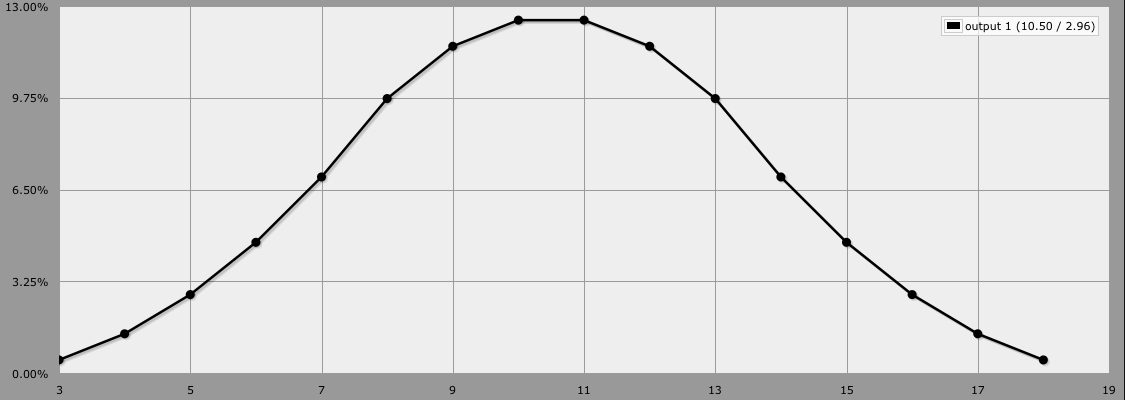
3d6

It’s the bell curve for Attribute distributions generated by rolling 3d6, which was how many a D&D session began. Throw three dice six times, record the scores next to the Attributes in sequence, and charge into the dungeon with your voulge drawn.

In addition to looking pleasantly symmetrical, that bell curve says something. It says that, when you roll multiple dice to obtain a single outcome, you’re likely to see a cumulative number in the middle of the possible range of outcomes. That’s why an average Attribute in D&D is a 10; it’s why you rolled 3d6 instead of 1d20. Indeed, if you rolled 1d20, the bell curve would look like this:

1d20

That’s not a curve at all. That’s an equal likelihood of any given outcome, with no range more common than any other. In the 3d6 bell curve, a 10 or 11 is more likely the outcome than a 3 or 18. In the 1d20 curve, 3, 10, 11, and 18 are all equally likely (as are all other numbers in the 1-20 range), at a five-percent chance of occurrence each.

Now, everyone around the table is disappointed when a cleric calls up a healing spell and, after much anticipation, rolls a 1. Rolling 1d8 for cure light wounds or cure wounds, depending on your edition of preference, is a bit of a letdown. It’s good for creating a hardcore, let-the-dice-fall-where-they-may moment, but it’s not good for creating a heroic moment. That standard 1d8 curve looks almost exactly like the 1d20 curve. Each outcome is equally probable, since you’re rolling only one die.

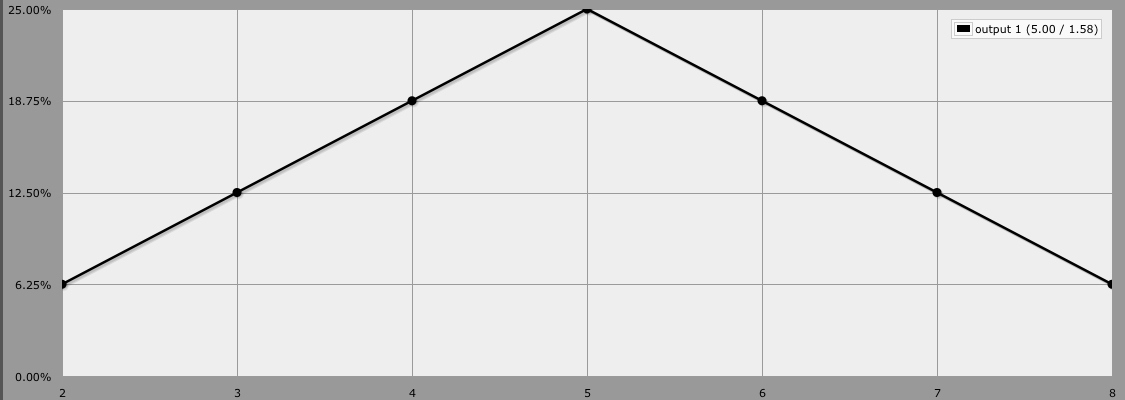
1d8

Taking a cue from that 3d6 bell curve, we can make it more likely for the cleric’s spell will generate a greater number of hit points cured. By making the cleric’s cure spell heal 2d4 hit points as opposed to 1d8, the flat curve instead becomes a peaked line, with the most likely outcome being a 5 — and, most importantly, that 5 is four times more likely to be the result than the lowest yield, the humble 2 (which, itself, is still twice the recovered hit points than the possible 1 from 1d8 allows…).2d4
In fact, the 5e rules have an element of this in place. Cure wounds still operates on a flat 1d8 roll, but potions of healing do indeed use a 2d4 base roll, with an additional +2 modifier to that roll, which keep the peaked line but just shifts the range of values up by two.
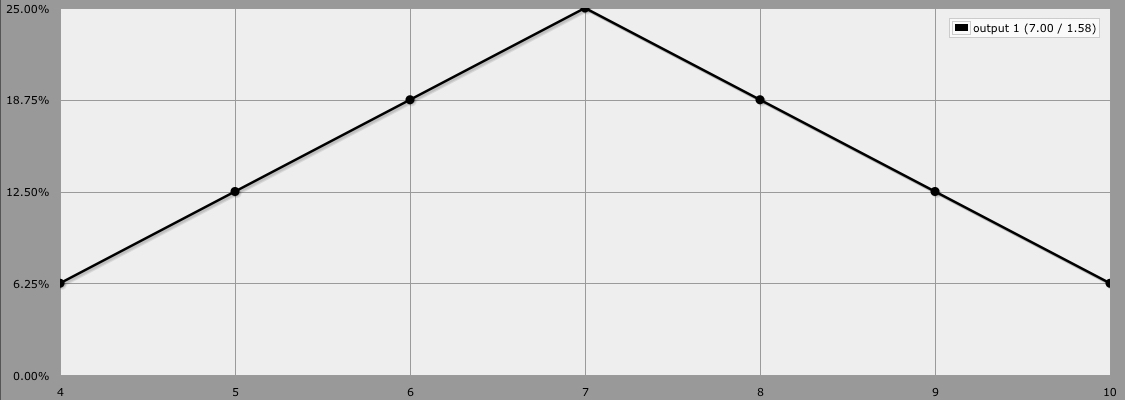
2d4+2

But you know this, so let’s get to the point.

Deciding how to distribute your randomized outcomes plays a large part in supporting the essential experience of your game. If you want more of those satisfying, “heroic” moments in which a supportive character can generally be relied upon to give a substantial boon to the other characters, consider house-ruling to a 2d4 per level roll instead of the standard 1d8 per level. To represent those high-tension, what-does-Fate-have-in-store moments — a decidedly old-school flavor in which the gods’ favor is fickle, even for their chosen — the 1d8 method works well. Think about the campaign you’re running. Are the players’ characters considered to be “heroes”? Or are they more morally ambiguous, dime-a-dozen “adventurers”? Later editions of D&D embrace the former, while earlier editions and games like Dungeon Crawl Classics posit the latter.
MageSpread

Obviously, working with your probabilities and value ranges need not stop with D&D. Using the Life Sphere in Mage, for example, a Storyteller may set the difficulties for healing magic at 1 lower than standard, if she wants the chronicle to feature more durable characters, or if the theme of the game revolves around healing or nurturing. A Call of Cthulhu Keeper may grant a bonus to an experience check to represent characters who rapidly increase in competency. A Dungeon World GM may halve common monster damage rolls but increase the number of monsters the characters encounter, to give a sense of high-powered adventurers possessing advantage over lesser foes, while keeping the damage rolls of boss-type monsters unmodified — or even increased, to highlight the disparity between monstrous rabble and more significant antagonists.

That essential experience is key, and I’ll return to it frequently when discussing design. The systems of the game must support what the game intends to communicate, otherwise the rules won’t convey the setting, nor will they help communicate what the game is “about.”

Thanks to anydice.com for the dice probabilities calculator.

Invoking Fail States

When it comes to game resolution systems, the question each system attempts to answer is fundamental: Is it interesting to either fail or succeed?

If either the failure to perform an action or the success in performing an action is interesting in terms of the game outcomes, that’s when you allow fate to intervene (i.e. roll dice or use whatever resolution mechanic exists).

If the either/ or isn’t interesting — if it does not provide a new choice to be made — don’t roll dice. At best, they’re an obstacle in that case. At worst, you’ve created a false expectation for the player.

Certainly, acknowledge the player input:

“I use Egyptology to search for clues.”

“You spend an hour comparing your notes to the strange cartouche, but the hieroglyphics don’t actually seem Egyptian at all, and you’re unable to decipher them.”

And note that, adjudicated wisely, even failure can yield information. In this case, the fail state indicated which direction not to go, pointing the players toward another decision on the manner of approach.

It’s important to construct your game progressions so they don’t rely on a certain die roll — again, unless the failure to achieve that progression is part of the game. If the players can’t find the clue because they failed a die roll, that stops the game. If the players can’t find the clue because of a certain die roll but they have other avenues of progressing the game available to them, that’s fine, but only if the possibility of exhausting the failed avenue leads them to another decision point. Relying on dice or other randomizers to determine an outcome skews the game away from a game of decisions toward a game of chance. Skill systems, in particular, which can create choke points in either information flow to the players or can block narrative progression, are particularly susceptible to these systemic blockers.

“We have exhausted our options because the dice say so” is bad game design, as it subsequently prevents players from interacting with the game and making the decisions that are fundamental to the definition of gameplay.

Best Construction

image

With this construction, the players know what they need to do and have choices to make as to how to arrive at the goal. (They may or may not know how to approach the challenge, and some choices may not work at all, but they can get what they need to overcome it and can choose from among their options.)

Good Construction

imageThe players know what they need to do and how to arrive at the goal. (They may or may not know how to approach the challenge, but can get what they need to overcome it.)

Bad Construction

image

The players know what they need to do and how to arrive at the goal, but have minimal to no control over that action’s success.

Worst Construction

image

The players know what they need to do and how to arrive at the goal, but have minimal to no control over that action’s success. Even worse, they have the illusion that their choice really matters, when it ultimately comes down to chance.

Important: Remember, this is not an argument against all dice rolls, but against dice rolls that would result in a hard stop in the progression of the essential experience.

RPGs by Threes

If you’re familiar with video games, you’re probably familiar with Shigeru Miyamoto, or at least his work. He’s the designer and producer behind some of Nintendo’s classic titles and game lines, including Super Mario Brothers and The Legend of Zelda. His design foundation consists of three steps that allow the player to learn and use game mechanics:

  1. Introduce the feature in a limited environment
  2. Expand the environment in which the player can use the feature, with numerous opportunities to expand competency with the feature.
  3. Require the player to use the feature as a benchmark to progress to the next challenge.

So, for example:

  1. Press a button to jump
  2. Introduce an enemy or environmental hazard that must be jumped; repeat
  3. “Boss fight” or other checkpoint that requires adept use of the feature to overcome.

(If you’re familiar with self-determination theory or the PENS model of player engagement, you’ll immediately recognize the elements of mastery and autonomy as motivating components. And if you’re familiar with Raph Koster’s Theory of Fun, you’ll notice the strong element of learning and applying what’s learned driving all three of those.)

This “rule of three” works very well for video games, in which feature progression and increasing difficulty of skill challenges forms the crux of the experience. These apply to good RPG systems design, as well.

image

Consider the way many spell systems or other special effects scale with level in level-based systems like D&D/ Pathfinder, or with the increase in the effect itself in systems like Vampire’s Disciplines. A level-one spell or Discipline creates a very finite effect, and one of very localized scope. Combat spells can be used to clobber small foes, for example, and themed Disciplines can create a narratively defined effect, like controlling shadows. Progression increases key elements of the feature’s characteristics: a spell’s area or range, an attack’s damage, a new application of the themed element. In this way, character progression becomes just that: a progressive increase in competency or potential rather than just a hodgepodge of new powers dumped onto the character.

Using these in the context of the players’ story creates the campaign, chronicle, or what have you. One-two-three forms a loop, and repeating that loop a number of times contitutes a session, episode, chapter, adventure, or whatever parlance you choose to use.

Unlike many video games, these feature progressions in RPG systems design are often cooperative, and individual challenges aren’t overcome by single players, but rather by the group collectively applying its abilities. A cleric heals while fighters fight and wizards summon or direct damage, for example, or the Toreador undermines an enemy’s status while the Gangrel and Brujah lie in wait outside Elysium to stomp the rival into respecting the coterie. (Certainly, many video games do this, but it’s the raison d’être of tabletop RPGs.)

Importantly, these progressions are the methods by which players solve problems. If a game is a series of problems for which the players employ their choice of solutions, each feature is then an atomic tool for finding those solutions. Sometimes a problem needs only a single tool to solve and sometimes an array of features is necessary to overcome the challenge, but the key is in making sure the player:

  1. Has one or more themed inputs by which he can affect the environment
  2. Knows how to use the inputs, in terms of game mechanics, and
  3. Can use the inputs in creative ways to address the challenges posed by the game